
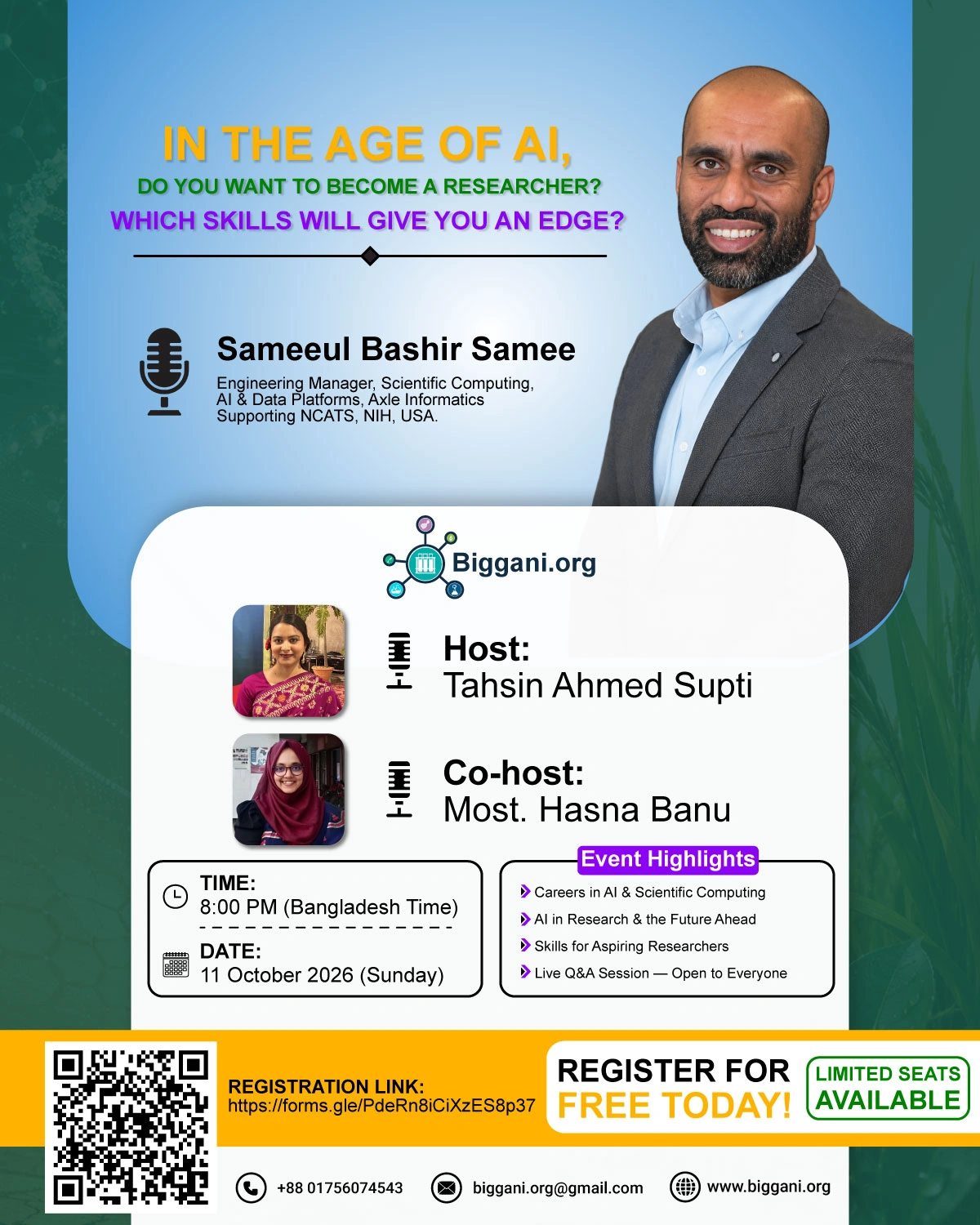
Scientific research is no longer confined to laboratories. Artificial intelligence, high-performance computing, massive biomedical datasets, and open-source software are rapidly transforming the way modern research is conducted. To learn from the experience of an engineering and technology leader whose academic and research journey began in Bangladesh and who is now directly involved in this transformation, biggani.org is organizing a special interview.
Our guest is Sameeul Bashir Samee, currently Engineering Manager, Scientific Computing, AI & Data Platforms at Axle Informatics, supporting NCATS, NIH, USA. With more than 15 years of professional experience, his work spans scientific computing, high-performance computing, AI-powered biomedical research platforms, numerical methods, health-data interoperability, and open-source software.
Beginning His Research Journey in Bangladesh
Sameeul Bashir Samee began his academic and research journey in Bangladesh. He earned his bachelor’s degree in Mechanical Engineering from the Bangladesh University of Engineering and Technology (BUET). As an undergraduate, he worked as an Undergraduate Research Assistant at the Bangladesh Atomic Energy Commission, where he contributed to developing computational models for the thermal assessment of the cooling system of the 3MW TRIGA MARK-II Nuclear Research Reactor.
He later moved to the United States and earned a master’s degree in Mechanical Engineering from the University of Cincinnati, followed by another master’s degree in Applied Mathematics. This combination of engineering, mathematics, and computing became an important foundation for his professional career.
From Aerospace to Biomedical Research
An important chapter of his career was at Siemens Digital Industries Software, where he worked on numerical solvers and high-performance computing for NX Nastran. His work contributed to the development of software used in aerospace, automotive, and industrial simulation.
Today, an important part of his work involves Ichnaea, a browser-based, AI-powered platform that enables researchers to view, annotate, and use AI to segment multi-terabyte biomedical imaging datasets. This work also supports research involving brain blood vessels and sickle cell disease in collaboration with researchers across NIH institutes.
At the same time, he leads engineering work on technologies designed to improve interoperability among different health-data standards, including OMOP, PCORnet, HL7 FHIR, and CDISC.
Open Source, AI, and the Future of Science
Another important aspect of Sameeul Bashir Samee’s work is open-source scientific software. He has been involved with projects such as bfio, argolid, sophios, nyxus, polymap, and termcord, which are designed for applications including large-scale bioimaging, scientific workflows, and healthcare data mapping.
AI also plays an important role in his current work. He has been developing an AI-augmented software development process in which AI agents assist with implementation and testing, while engineers retain key responsibilities for architecture and review.
Why Should Students in Bangladesh Join This Interview?
For students in Bangladesh who dream of becoming scientists, researchers, or technology professionals, there is much to learn from Sameeul Bashir Samee’s journey. From undergraduate research in Bangladesh to higher education in the United States, industrial scientific computing, and later biomedical research technology, his career demonstrates how an educational foundation in one discipline can gradually develop into an interdisciplinary career.
In this biggani.org interview, we will explore how students can begin their journey into research, prepare for higher studies, strengthen their foundations in mathematics and programming, contribute to open-source projects, and develop the skills needed to prepare themselves for the future as engineers and researchers in the age of AI.
For school, college, and university students interested in scientific computing, artificial intelligence, biomedical technology, software engineering, mathematics, higher studies, and research careers, this conversation will provide an opportunity to learn directly from the real-world journey, work, and experience of an accomplished professional.
Event Information
📌 Registration: https://forms.gle/CtZfLDDr5tGcKRCn6
The meeting link will be sent only to registered participants.
Date: Sunday, 11 October 2026
Time: 8:00 PM (Bangladesh Time)
Host: Tahsin Ahmed Supti
Co-host: Hasna Banu
Stay connected with biggani.org—learn, ask questions, and explore new horizons in science, research, and technology.
biggani.org — Inspiring Bangladesh’s science-minded generation since 2006.